Field-testing RIVeR against ADCP measurements in Costa Rica
At a WMO HydroHub workshop on the Río Grande de Orosí, a RIVeR discharge estimate from a single oblique video matched a six-transect ADCP reference within its uncertainty margin.



A field test, not a lab result
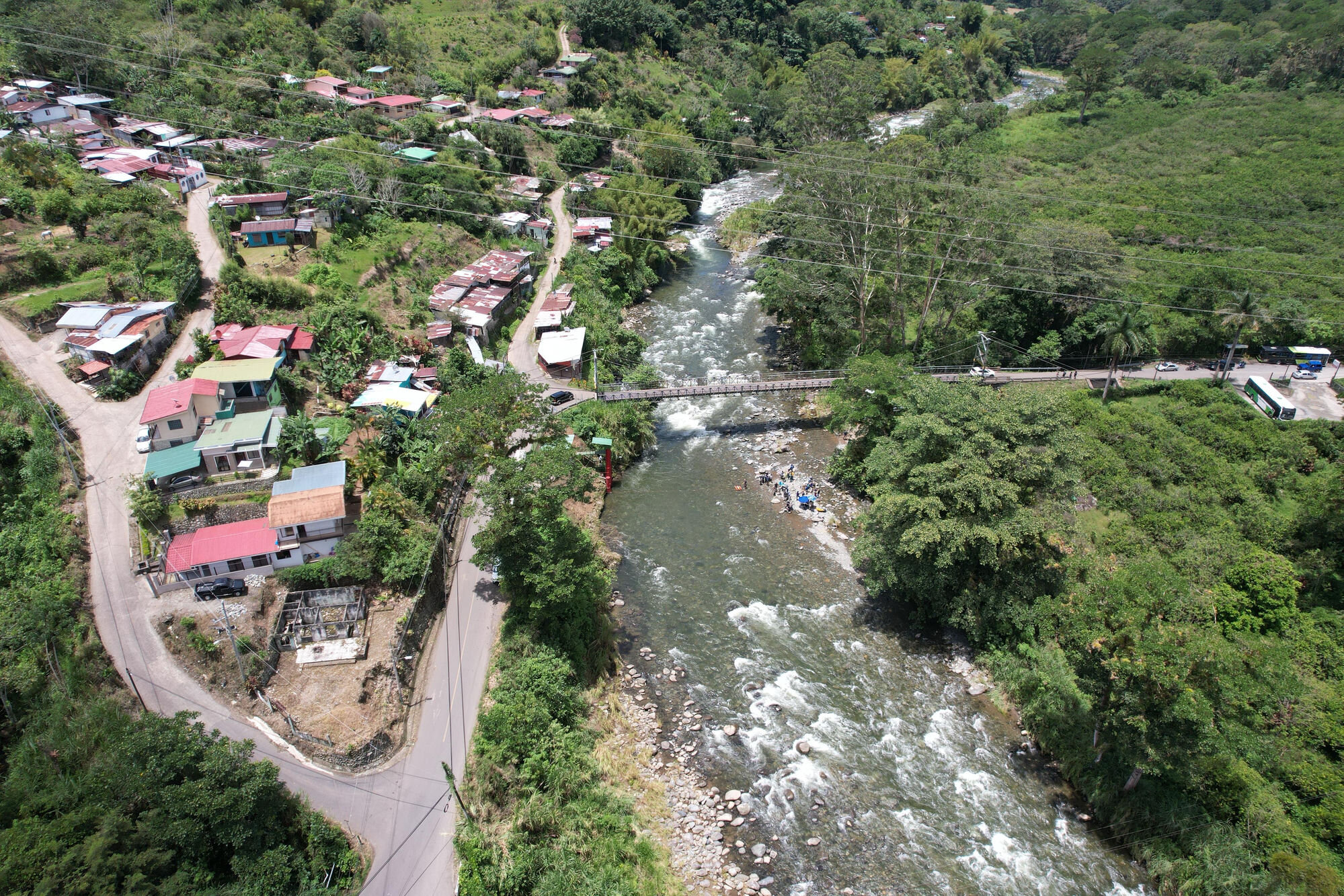
In May 2025, the WMO HydroHub ran a Field Workshop on Innovative Hydrometry, bringing hydrometry practitioners together to test different river-monitoring techniques side by side, in the field rather than in a lab. One of the sites was Station #9-19 on the Río Grande de Orosí, reached by a footbridge over fast, shallow water running past a small town.
There, on May 22 and 23, workshop participants recorded an oblique video of the river and used RIVeR to estimate its discharge, the same image-based technique behind the RIVeR-LAC project. No instrument touched the water for that estimate: a camera, a video, and RIVeR's rectification and velocimetry pipeline were enough.
RIVeR turning a video of the river into a surface-velocity field, ready to calculate discharge.
How it compared to the ADCP
For a real check, the workshop also measured the same reach with an ADCP (a SonTek RiverRay), profiling six transects to get a reference discharge of 25.8 m³/s. That measurement was not a clean one either: the water level was slightly rising during the gaugings, and part of the right bank could not be measured at all, both of which add uncertainty to the reference itself. Using QRev, that uncertainty was estimated at ±12.5%.
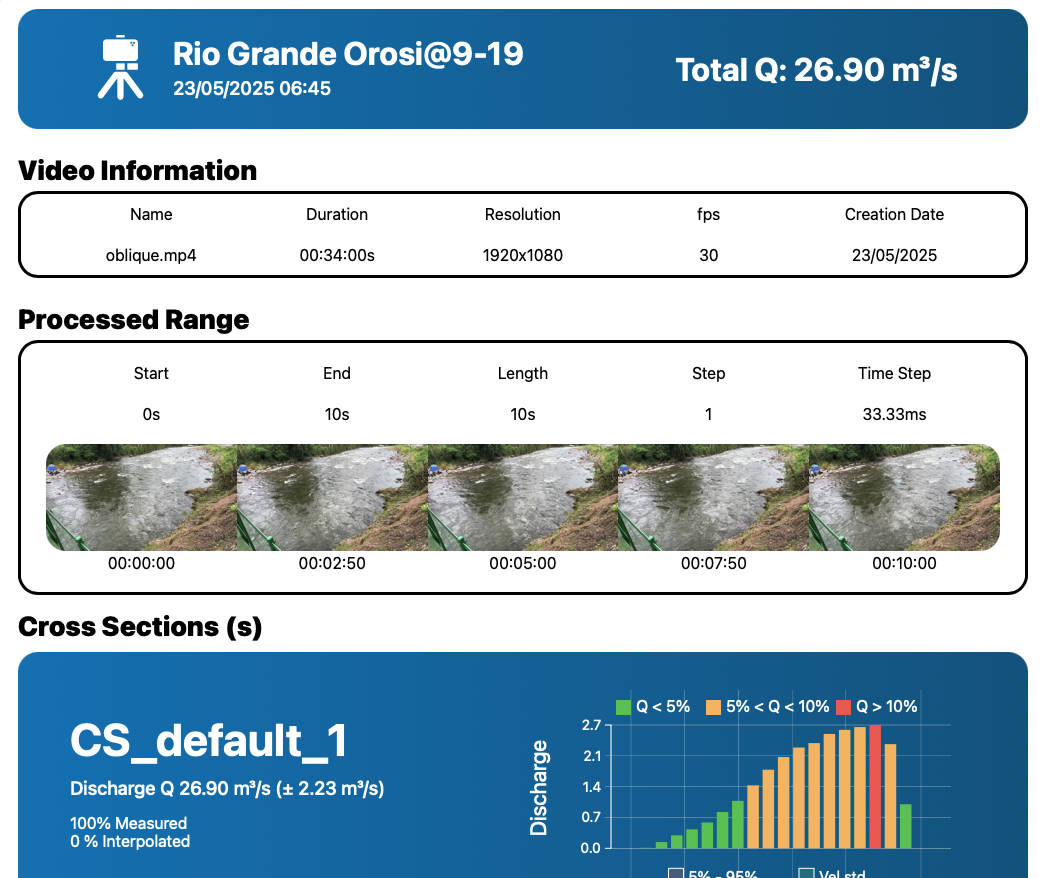
RIVeR's own report put the video-based estimate at 26.90 m³/s (±2.23 m³/s), fully inside the ADCP's uncertainty range. For a single oblique video, processed by workshop participants rather than by the RIVeR team, that is a strong result under real, imperfect field conditions rather than a controlled test.
Open for anyone to try
This validation came out of the same open-source RIVeR that RIVeR-LAC rebuilt, run by workshop participants on a river none of them had measured before. The full report, with the video details, cross-sections and discharge breakdown, is public, and so is the discussion where these results were first shared.
Thanks to the WMO HydroHub team, the Costa Rican Institute of Electricity (ICE) as local partner, and everyone at the workshop who made this test possible.
“Good agreement with the ADCP result, under real-world field conditions.”
Result of the Costa Rica field validation, May 2025